
Exp lanation Regarding Re-Authentication
We received a request for re-authentication. As a rule, however, we do not conduct re-authentication unless there is a substantial reason to do so.
In this case, we made an exception because we believed the process may also be informative to those viewing this response.
Inquiry
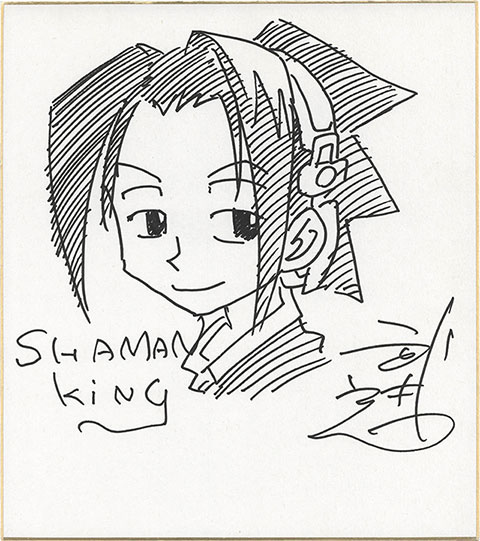
Images of the winning items from the Zenbu Issue 133 Grand Auction, as requested
Hand-Drawn Shikishi) by Hiroyuki Takei : " Shaman King"
Hello. My order ID is XXXXX.
I am contacting you regarding this matter.
I won and paid for a hand-drawn shikishi by Hiroyuki Takei, the creator of Shaman King, through an auction, and I have already received the item.
Afterward, I showed it to some friends, and they told me, “This is almost certainly fake.”
The reason is that, compared with other Hiroyuki Takei shikishi, the drawing style appears quite different.
Please check the attached images.
My question is: how does your company verify authenticity each time?
I performed a Google image search, but I could not find any matching image.
I also researched the explanation that the item was “sold at a charity auction held during the Tezuka/Akatsuka Award party around 2000,” but I could not find any information supporting that claim.
For these reasons, I am concerned that this item may be fake.
If you have any materials or grounds that can prove this item is authentic, would you please provide them?
I would appreciate your confirmation and response. Thank you.
The fact that Mandarake does not publicly disclose its authentication procedures, methods, or detailed data is not a weakness. It is done to prevent counterfeiting, protect personal information, and preserve the market.
However, as an exception, we will disclose the following information on the condition that it is made public.
[Subject]
Response Regarding the Authenticity of Order ID: XXXXX, Hand-Drawn Shaman King Shikishi
Dear XXXXX,
Thank you very much for winning the Shaman King shikishi in the Mandarake Auction, ZENBU No. 134. We have also received your important question regarding authenticity. Below, we provide our authentication opinion and explanation regarding the legitimacy of the item.
Please note that, as a rule, we do not externally disclose individual authentication processes or detailed acquisition routes. However, in this case, as a special exception made on the condition that the contents be publicly disclosed, we will provide details in order to demonstrate the transparency of the auction and our absolute confidence in our authentication judgment.
Question 1
Acquisition Route and the Facts Regarding the “Tezuka/Akatsuka Award Party”
You pointed out that there is no online record of the relevant charity auction. However, records of charity events held within limited, invitee-only social gatherings around the year 2000 would almost never be indexed by general Google searches. It is a mistake to treat online information as omnipotent.
The first public appearance of this item was in Mandarake ZENBU No. 42, published by our company in 2009. At that time, we accepted the item after conducting strict authentication. In response to your inquiry, we have once again performed re-authentication and reviewed the circumstances surrounding the purchase at that time.
Detailed Acquisition Route: Disclosure of Primary Information
In 2009, the person who brought this shikishi to our company was Mr./Ms. ●●, whose real name is known to us, and who had worked as an assistant to a well-known manga artist associated with Weekly Shonen Jump.
In the winter of 2000, Mr./Ms. ●● officially attended the “Tezuka-Akatsuka Award Party” accompanied by his/her mentor, a manga artist who works for *Jump*. It is an indisputable fact that, at the charity auction held at the venue, he/she purchased the *Shaman King* autographed card we have sent you, along with a *NARUTO* T-shirt that was being auctioned as part of the same lot.
On-Site Facts Regarding the Drawing Style
Because the style of the shikishi appeared relatively “loose” or improvisational, our authenticator directly asked Mr./Ms. ●● whether it had been drawn on the spot at the party venue.
At that time, we directly received the testimony that “all shikishi prepared for the charity event had been created in advance by the artists and brought to the venue; they were not live drawings made on site.”
Please note that on that day, Mr./Ms. ●● also received handwritten autographs from other artists at the venue. However, because all of those autographs include dedications addressed to Mr./Ms. ●●, they remain in their possession as treasured items. Only the undedicated Shaman King shikishi and the NARUTO T-shirt were sold to our company.
We possess reliable primary information and material evidence that cannot be reached through internet searches, including the seller’s identity, their attendance history at the time, and consistency with other items brought in at the same time. For personal information protection reasons, we cannot disclose the name any further, but even this alone constitutes sufficient grounds.
“It does not appear on Google” does not mean “it does not exist.” In particular, for charity items from events held around the year 2000, the absence of online records is entirely natural.
Question 2
Critical Error Regarding the Images Presented by the Customer as Comparisons
You submitted reference images, including images from the website of ●●●●●●●●●, claiming that the style differs from other Hiroyuki Takei shikishi. However, there is a critical flaw in that verification process.
To state the conclusion first, the shikishi in the image that you presented as an authentic standard is either a mass-produced shikishi in which the artwork is printed and only the signature is handwritten, or an item of extremely low reliability that was later reposted and circulated online.
Reliability of the Comparison Item
The site you presented states that the item was “received in 2022,” but in reality, there is a strong possibility that it reused an image from a Yahoo! Auctions listing from 2018. This raises serious questions about the reliability of the seller’s own description. This type of shikishi, where the artwork is printed and only the signature is handwritten, has appeared on the market multiple times in the past, and our company’s data includes clear handling records as well as identification data showing that the artwork is printed.
In other words, the image you used for comparison as “another Hiroyuki Takei shikishi” is, at least with regard to the artwork portion, not a hand-drawn illustration.
Using that comparison item to judge that “the style differs too much from this shikishi” is equivalent to comparing the lines of a printed or reproduced piece with the lines of a hand-drawn original shikishi. As an authenticity judgment, the premise itself is invalid.
In a hand-drawn work, there are factors such as pen pressure, line speed, hesitation, stopping points, line entry and exit, ink deposition, contact with the paper surface, simplification at the time of production, and variation depending on the scene, purpose, and period in which it was drawn. One cannot simply compare the design of a commercial printed item or printed shikishi with the lines of a unique hand-drawn piece.
The core issue here is not that “there are grounds to determine this shikishi is fake,” but rather that “the image used as the comparison item is itself inappropriate as reference material for comparing hand-drawn artwork.”
In other words, you are treating the uniform lines of a reproduced mass-produced item, whose artwork is printed, as the standard, and using that to suspect as fake a genuine hand-drawn work, equivalent to an original manuscript, that the artist personally drew one by one for charity at the time. It is only natural that the crisp lines of a printed item differ from the hand-drawn touch applied directly to a shikishi. Using a fake, or a reproduction of a fundamentally different nature, as the standard for authenticity comparison is, from an authentication standpoint, completely flawed logic.
Based on Mandarake’s long-standing authentication policy centered on physical examination of actual items, we responsibly judge this item to be authentic.
It is impossible for the general public to identify the many so-called “handwritten fakes” flooding online auctions and flea-market apps through image searches alone. That is precisely why collectors around the world trust our authentication and submit an enormous number of requests to us every day.
Mandarake’s authenticity assessment is not based on individual subjectivity or internet searches. It is operated based on the following unparalleled organizational strength and data.
One of the World’s Largest Data Archives
Comparison against more than 200,000 handwritten items and over 2.55 million related data entries accumulated over 45 years, including authentic handwriting, drawing ability, and paper-quality data.
Professional Authentication Team
- 7 master professional authenticators with 45 years of authentication experience
- 19 authentication experts across various genres
- 3 authentication technicians and archivists
- 5 conservators specializing in preservation, restoration, and scientific verification
Authentication Results for Fiscal Year 2026
Total annual authenticated value: 1.94 billion yen
Our company also possesses many other confidential scientific and artistic authenticity factors, including ink, sumi ink, pigment oxidation levels, paper dating, and artist-specific stroke tendencies. For security reasons, these are not disclosed under any circumstances.
The hand-drawn Shaman King shikishi delivered to you has cleared all of these strict standards, and its provenance, from a person connected to Jump, has been fully identified. It is a 100% unquestionable authentic work. Please enjoy it with peace of mind as a one-of-a-kind treasure in your collection for many years to come.
We sincerely appreciate your continued support of Mandarake.
Mandarake Authentication Committee / ZENBU Auction Department